


The Bank of Canada has held its overnight rate at 2.25% six times in a row, most recently on July 15, 2026. Yet five-year fixed mortgage rates are back above 4%. Those two facts are not a contradiction. Fixed rates follow the bond market, not the Bank — and the bond market is pricing a war.
The five-year Government of Canada bond yield closed at 3.29% on August 14, 2026, and the best available five-year fixed mortgage rates now sit between 3.94% and 4.09%. The Bank of Canada did not move any of that. A tanker route on the other side of the world did.
Where things actually stand
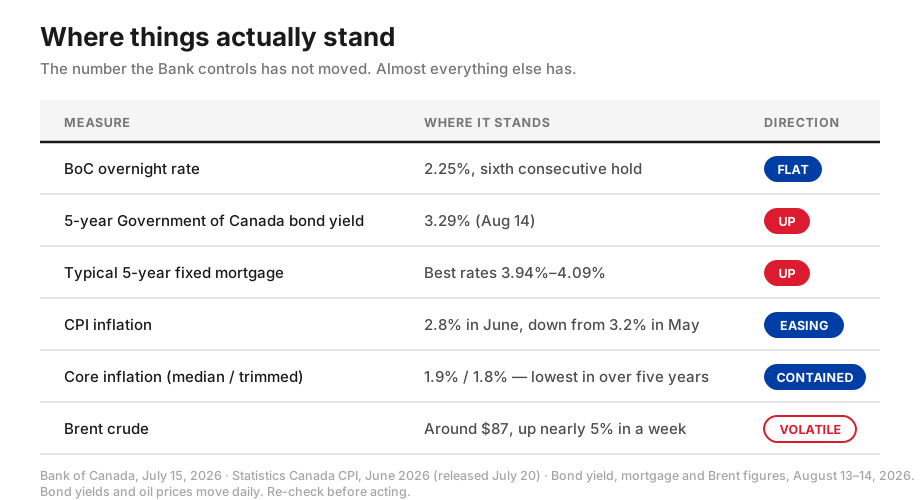
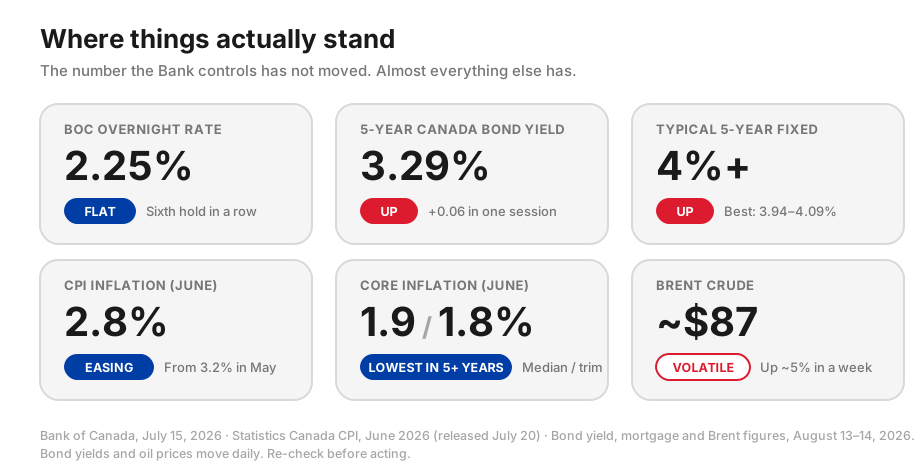
Read that table top to bottom and the story tells itself. The number the Bank controls has not moved. Almost everything else has.
Why did my fixed rate go up if the Bank of Canada did nothing?
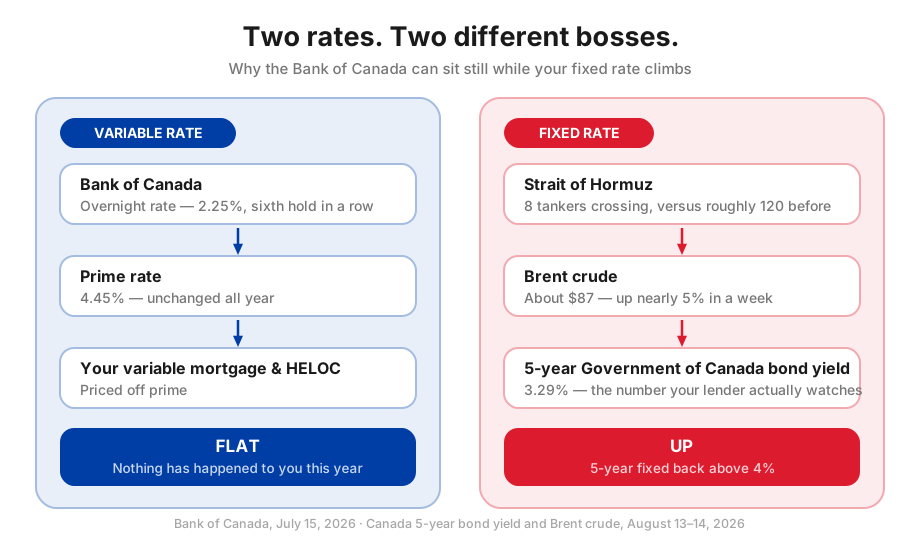
Because they are two different rates driven by two different things.
The overnight rate sets what banks charge each other for overnight money. It flows through to prime — currently 4.45% — which is what your variable-rate mortgage and your line of credit are priced from. That rate is sitting still, and has been for six meetings.
Five-year fixed mortgages are priced off the five-year Government of Canada bond yield. Lenders borrow at roughly that yield and lend to you at a spread above it. When the bond yield rises, fixed mortgage rates follow within days, and the Bank of Canada does not get a vote.
That yield climbed to 3.29% on August 14, up six basis points in a single session. So fixed rates moved. The Bank did not.
The take: if you hold a variable mortgage, nothing has happened to you this year. If you are shopping for a fixed rate, quite a lot has.
Is the war actually pushing Canadian rates up?
Yes — but indirectly, and almost entirely through oil.
The Bank was blunt about it in July: global economic prospects “have been dented by higher oil prices stemming from the Middle East conflict.” Canadian inflation hit 3.2% in May, and the Bank attributed that mainly to higher gasoline prices linked to the conflict.
June brought relief. Inflation eased to 2.8%, almost entirely because gasoline fell in the month after an interim ceasefire cooled crude. Gasoline was still up 20.5% from a year earlier, but that was far better than May’s 33.2%.
That relief did not last. Brent fell as low as $69 on July 2 after a US–Iran memorandum, then spiked to $105 on July 23 following attacks on tankers in the Strait of Hormuz. It sits near $87 today, having gained nearly 5% in a week as Iran stated the Strait will not reopen until its conditions are met.
The physical picture is the part most coverage skips. Roughly eight vessels are now crossing the Strait, against about 120 before the conflict. The U.S. Energy Information Administration responded by lifting its 2026 Brent forecast to $87 a barrel, up from $82.
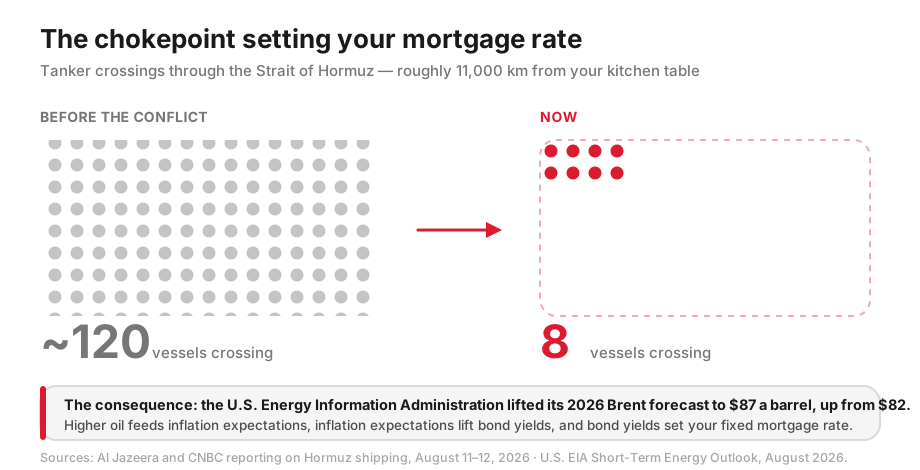
So the pressure is real. It is also imported. This is not Canadian wage growth or domestic demand overheating. It is a shipping lane two oceans away — and that distinction matters enormously for what happens next.
What would actually make the Bank of Canada raise rates?
Central banks generally look through an oil shock. A one-time jump in fuel prices raises the price level but does not, by itself, create sustained inflation. Raising rates to fight it would slow an already soft economy without touching the cause.
The Bank only has to act if the shock stops being one-time. Two things would signal that.
The first is inflation spreading beyond energy. Right now it has not — and this is the single most reassuring number in the whole picture. The Bank’s own preferred core measures both fell in June: median core to 1.9% and trimmed-mean core to 1.8%, their lowest readings in over five years. Headline inflation is being pushed around by gasoline. Underneath it, price pressure is not just contained, it is easing.
The second is expectations coming unanchored. If households and businesses start planning for permanently higher prices, that behaviour becomes self-fulfilling. Governor Macklem has said that if oil reached roughly US$100 a barrel and fed “more persistently” into inflation, hikes could become necessary.
Brent touched $105 in July. So this is not a hypothetical — it is a live scenario. But the Bank still projects inflation returning to around 2% in early 2027.
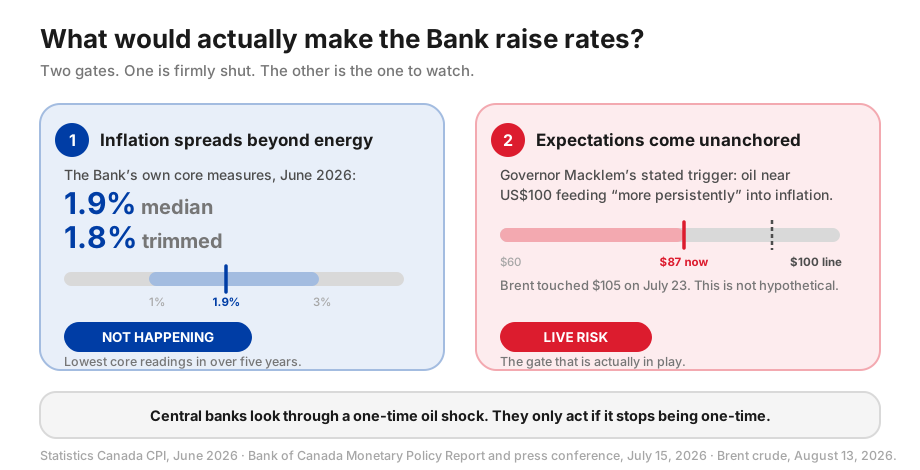
The take: gate one is firmly shut, and moving further shut. Gate two is the one worth watching — and it is watched most cheaply by watching the price of oil.
What are economists actually forecasting?
The consensus is remarkably united on the near term and divided only on the timing of the eventual move.
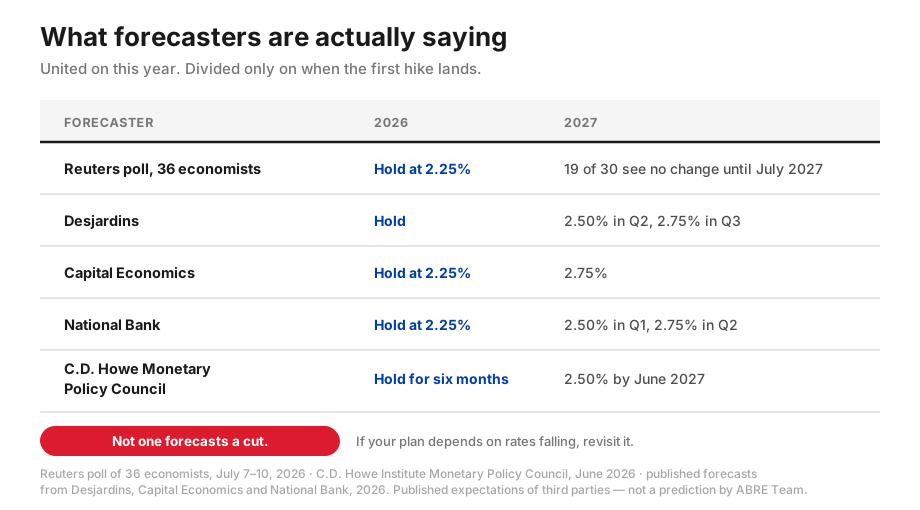
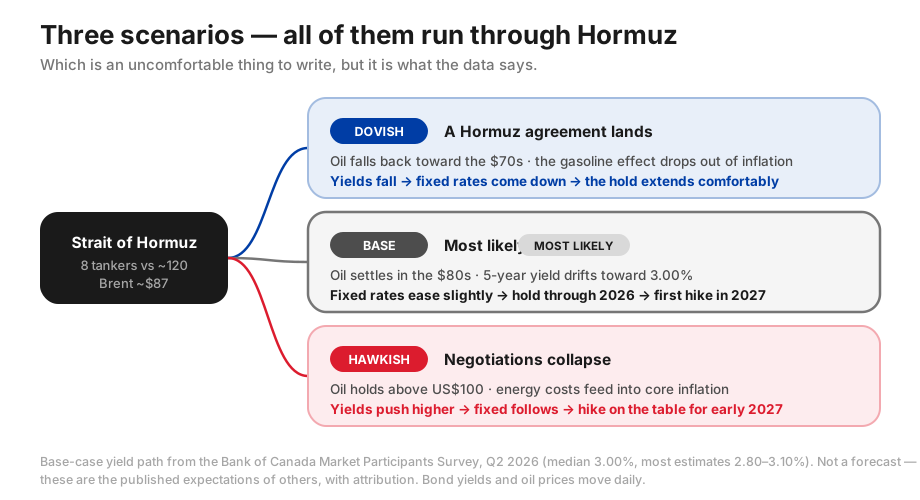
Every one of them says the same thing about this year: no change. Where they differ is whether the first hike lands early or late in 2027, and whether it stops at 2.50% or continues to 2.75%.
Worth noting that not one of them forecasts a cut. If your plan depends on rates falling to rescue affordability, that plan needs revisiting.
Three scenarios worth holding in mind
Base case, and the most likely. The overnight rate stays at 2.25% through 2026. Oil settles somewhere in the $80s. The five-year bond yield drifts toward 3.00% — the median expectation in the Bank’s own Market Participants Survey, with most estimates between 2.80% and 3.10%. Fixed rates ease slightly. The first hike arrives in 2027.
The hawkish case. Hormuz negotiations collapse, oil holds above US$100, and higher energy costs work through into core inflation and expectations. Bond yields push higher, fixed rates follow, and a hike moves onto the table for early 2027. This is the scenario Macklem described, not one I am inventing.
The dovish case. A Hormuz agreement lands, oil falls back toward the $70s, and the gasoline effect drops out of the inflation numbers. Yields fall, fixed rates come down, and the hold extends comfortably.
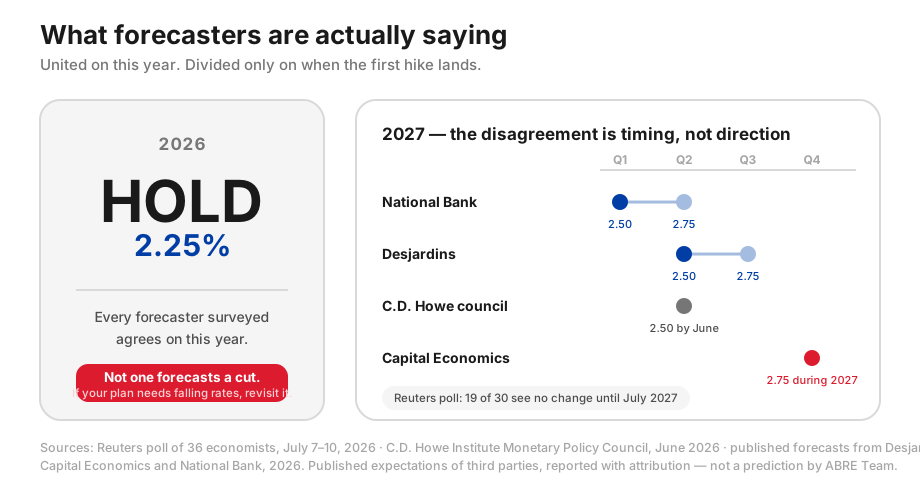
Notice that all three run through the Strait of Hormuz. That is genuinely where Canadian fixed mortgage rates are being decided right now. It is an uncomfortable thing to write, but it is what the data says.
What should I do about fixed versus variable?
I am not going to tell you which to take. That depends on your income stability, how long you plan to stay, and how you sleep. But the trade-off is unusually clear at the moment.
Variable is priced off a rate that has not moved in six meetings and that nobody surveyed expects to move this year. The risk is 2027, and the risk is upward.
Fixed has already absorbed the war premium. You are paying above 4% today partly for a conflict that may resolve. If it does, you will have locked in at a worse rate than someone who waited. If it does not, you will be glad you locked.
What I would avoid is the middle path of waiting for clarity. There is no announcement coming that makes this obvious. The July CPI release on August 17 and the Bank’s next decision on September 2 will move the numbers, but neither will settle the Hormuz question.
Who this changes things for
If you are buying now. Get your rate hold in writing and know exactly how long it lasts. Rate holds typically run 90 to 120 days, and in a market where fixed rates move within days of the bond yield, that hold has real value. Qualify at the stress test rate, not at the rate you hope to get.
If you are renewing. You are not stuck with your current lender. Straight switches — same balance, same amortization, same property — do not require you to requalify under the stress test. Shop it. If you add to the balance in the same step you lose that exemption, so handle any extra borrowing separately.
If you are selling. Your buyer’s budget is being set by the bond market, not by the Bank of Canada’s headline. Every 25 basis points on a five-year fixed reduces what a qualified buyer can carry. Price against the market that exists, not the one from the last rate announcement you read about.
If you are investing. With the five-year yield above 3% and commercial borrowing costs above that, the gap between your borrowing cost and your cap rate is the number to watch. When borrowing costs exceed the cap rate, additional leverage lowers your return rather than raising it.
Frequently asked questions
Is the Bank of Canada going to raise rates in September?
Almost certainly not. All 36 economists in a July Reuters poll expected a hold, and the Bank itself called the current policy rate appropriate on July 15, 2026. The next scheduled decision is September 2, 2026. The realistic debate is about 2027, not this autumn.
Why is my variable rate unchanged while fixed rates rose?
Variable rates follow prime, which follows the Bank of Canada’s overnight rate. That has been at 2.25% for six consecutive decisions, leaving prime at 4.45%. Fixed rates follow the five-year Government of Canada bond yield, which rose to 3.29% on August 14, 2026 on war and inflation risk. Different anchors, different outcomes.
Will fixed mortgage rates come back down?
They could. The Bank of Canada’s Market Participants Survey for the second quarter of 2026 shows a median expectation of 3.00% for the five-year yield by year end — below the 3.29% where it sits now — with most estimates between 2.80% and 3.10%. That points to modest relief, and it assumes the Middle East situation does not deteriorate further.
Does a war automatically mean higher interest rates?
No. Central banks usually look through energy shocks, because a one-time price jump is not sustained inflation. Rates only rise if the shock spreads into core inflation or unanchors expectations. Canada’s core inflation measures actually fell in June 2026, to 1.9% median and 1.8% trimmed — their lowest in over five years — which suggests it has not spread.
What is the single number to watch?
The price of Brent crude. Governor Macklem has indicated that oil near US$100 a barrel, feeding persistently into inflation, could make hikes necessary. Brent touched $105 on July 23, 2026 and sits near $87 in mid-August. Everything else follows from there.
How does the Strait of Hormuz affect a mortgage in Toronto?
Through four steps. Restricted tanker traffic through the Strait — roughly eight vessels crossing versus about 120 before the conflict — pushes oil prices up. Higher oil lifts inflation and inflation expectations. Those expectations push government bond yields higher. Canadian five-year fixed mortgage rates are priced off the five-year Government of Canada bond yield, so they rise within days.
What I would do next
If your mortgage renews within the next twelve months, start the conversation now rather than waiting for the letter. If you are buying, get the rate hold and understand its expiry date.
Then look at what is actually affordable at today’s rates, rather than at the rate you were quoted six months ago.
→ Take the affordability quiz — see which programs you qualify for, in about 90 seconds.
Or email [email protected] and I will look at your specific numbers.
Not financial, mortgage or tax advice. Rate levels, bond yields and oil prices move daily; the figures above reflect August 13–14, 2026 and should be re-checked before you act. Confirm details with a licensed mortgage professional.
Sources
Bank of Canada — interest rate announcement and Monetary Policy Report, July 15, 2026
Bank of Canada — Summary of Governing Council deliberations, July 15, 2026
Bank of Canada — Market Participants Survey, second quarter 2026
Statistics Canada — Consumer Price Index, June 2026 (released July 20, 2026)
Oil prices rise as attacks dent hopes for Strait of Hormuz reopening — Al Jazeera, August 12, 2026
Hormuz deadlock: where oil prices could head next — CNBC, August 11, 2026
U.S. Energy Information Administration — Short-Term Energy Outlook, August 2026
Reuters poll of 36 economists, July 7–10, 2026
C.D. Howe Institute Monetary Policy Council, June 2026
Published rate forecasts from Desjardins, Capital Economics and National Bank, 2026
Ali Bolourchi, BSc, MS, PSA, ABR®, Broker
ABRE Team — REMAX® Your Community Realty, Brokerage
8854 Yonge St, Richmond Hill, ON L4C 0T4 · [email protected]

Comments:
Post Your Comment: