


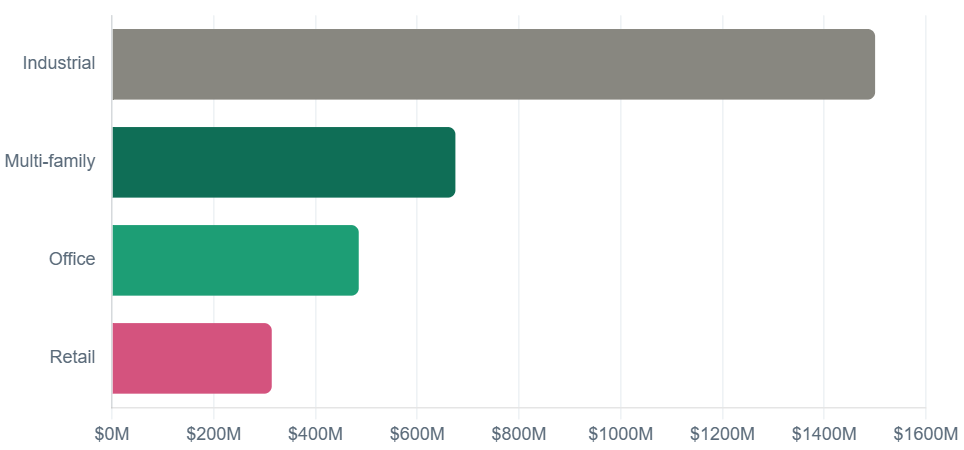
The short answer: In Q1 2026, GTA commercial investment held near $3.8 billion, down a slight 3% year over year. The headline hid the real story: multi-family residential investment surged 232% to roughly $675 million. While the market watched office vacancies, capital quietly moved into apartment buildings.
Headlines spent the quarter fixated on empty office towers. Meanwhile, the smart money was doing something completely different. It was buying apartment buildings, and it was buying a lot of them.
The Greater Toronto Area saw nearly $3.8 billion in commercial real estate transact in the first quarter of 2026. On the surface, that looks flat, a modest 3% dip from a year earlier. But underneath that calm number, one sector broke away from the pack in a way the broader market simply did not notice.
Where the capital actually went
When you break the $3.8 billion down by asset class, the divergence is impossible to ignore. Multi-family did not just lead, it ran away with the quarter. Office posted a strong rebound off a weak base, industrial stayed dependable, and retail fell off a cliff.
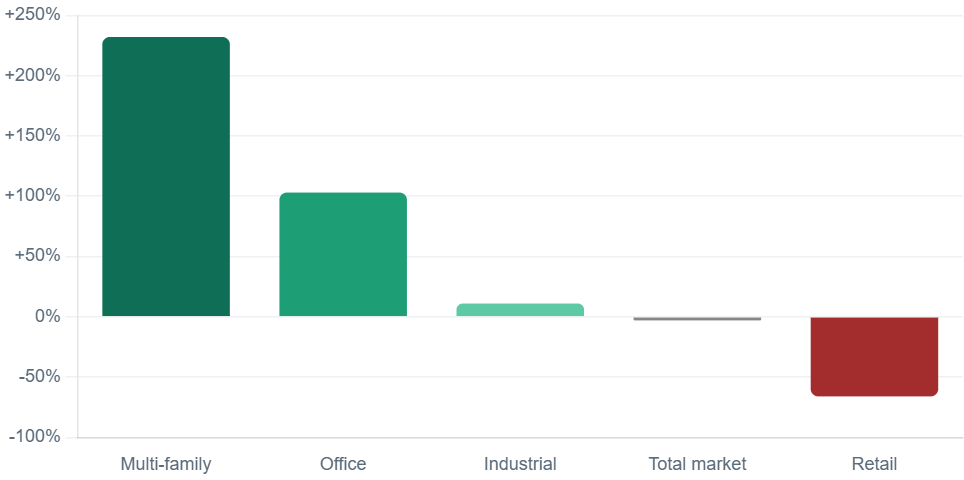
It is worth separating the percentage growth from the absolute dollars, because they tell two halves of one story. A 232% jump sounds explosive, and it is, but multi-family is still a mid-size slice of total volume. Industrial remains the heavyweight by dollars. The point is the direction of travel: money is rotating toward rentals.
The numbers, side by side
Within multi-family, the growth was not evenly spread. Toronto and Halton drove the surge, with year-over-year investment activity climbing roughly 569% and 90% respectively as buyers and sellers found common ground on price and financing visibility improved.
Why investors are crowding into apartment buildings
This is not a fad or a one-quarter blip. Three structural forces are pulling institutional and private capital toward rental housing at the same time.
1. Rental demand is structural, not cyclical
Canada's housing shortage and immigration-driven population growth keep apartment units occupied almost regardless of the economic cycle. When a region needs more homes than it builds, every rental unit becomes a near-certain income stream. That is the kind of reliability institutions pay a premium for.
2. Cap rates reward scale
Prime GTA multi-family currently trades around a 3.5% to 4.5% capitalization rate, with the national average closer to 4.6% by the end of 2025. Those are tight, aggressive yields. They do not reflect weak returns, they reflect how badly large investors want stable, recession-resistant income. You do not see cap rates that low on assets people are unsure about.
3. It is a direct hedge against the for-sale slowdown
Here is the elegant part. When would-be buyers hesitate, and with the Bank of Canada holding its overnight rate at 2.25% in mid-2026 many still are, those people do not vanish. They rent. Multi-family captures that exact demand. The same hesitation that cools the resale market actively feeds the rental market. Owning apartments lets an investor sit on the right side of that trade.
The lens that matters for private and mid-size investors
The lesson here is not "buy what the giants buy." Most private investors cannot write a cheque for a 200-unit tower, and chasing the exact same deals is a losing game. The real lesson is to understand why they are buying.
In a market like this one, durable cash flow beats speculative appreciation. The institutions piling into multi-family are not betting on prices spiking next year. They are buying income that shows up every single month, in good times and bad. That logic scales down. A well-located duplex, triplex, or small apartment building follows the same demand fundamentals as the towers, just at a size a private investor can actually own and operate.
The smartest moves right now are in assets people need, not assets people hope will rise. That is the lens I bring to every commercial conversation.
What this means for you
Buyers: Hesitation in the resale market is real, but it is also creating room to negotiate. With the Bank of Canada holding rates steady, financing is more predictable than it has been in two years. If you have been waiting for certainty, the picture is clearer now than at any point recently.
Sellers: If you own a multi-family or income-producing asset, you are holding exactly what the market wants most. Bid-ask spreads are narrowing and buyers are active. This is a window to test pricing from a position of strength, especially in Toronto and Halton.
Landlords: Structural rental demand is your tailwind. Occupancy is durable and the for-sale slowdown is funneling more renters your way. Focus on retention and unit quality now, because the demand backdrop supports steady, defensible rent.
Tenants: Competition for quality rentals will stay firm as buyers delay purchases and rent longer. Move decisively on units that fit, and lock in favorable lease terms early rather than waiting for supply to loosen.
Investors: Follow the logic, not just the headline. Prioritize durable cash flow over speculative upside, and look at small multi-family assets in the sub-markets where institutions are concentrating. The 232% surge is a signal of where stable income is being repriced, and you can participate at your own scale.
Thinking about a commercial or multi-family move?
I help private and mid-size investors read the GTA market the way institutions do, then act on it. Let us talk through where durable cash flow lives in today's numbers.
Visit The4Sale.com or reach me directly at [email protected]
Data sources: Altus Group Toronto Commercial Real Estate Market Update Q1 2026; Colliers GTA Multifamily Market Report Q1 2026; Cushman & Wakefield Canadian Cap Rates Report; Bank of Canada policy rate announcements. Figures are approximate and rounded. This content is for informational purposes and is not financial advice.
