RSS

Unlocking Your Next Real Estate Investment: A Guide to the CMHC MLI Select Program in the GTA

Introduction: A New Path for Toronto Real Estate Investors

For investors in the Greater Toronto Area, the rules of multi-unit real estate have fundamentally changed. Profitability is no longer just about location and market timing; it's about purpose. The government's most powerful financing tool, the CMHC MLI Select program, has been redesigned to directly link an investor's financial success to their project's social and environmental impact. This guide is your strategic playbook for mastering this new equation.

As a commercial mortgage broker specializing in CMHC financing, I will break down the core components of MLI Select, explain the critical new rules that took effect in 2025, and provide a clear blueprint for how you can leverage this program to achieve your financial goals while making a meaningful contribution to housing affordability and sustainability.
1. The Big Picture: Understanding the GTA's Current Rental Market

Before diving into the specifics of MLI Select, it's essential to understand the landscape you'll be operating in. The 2025 CMHC Rental Market Report revealed several key dynamics that every new investor in the GTA should be aware of.

  • Softening Market Conditions

    • An increase in rental supply combined with weaker demand from renters has caused vacancy rates to rise. For the first time since the pandemic, the vacancy rate for purpose-built rental apartments in Toronto reached 3.0%. For an investor, this means a slightly less frantic market, but also more competition to attract and retain tenants.

  • The Key Role of Tenant Turnover

    • While average rents for new tenants have stalled or even declined slightly, overall rent growth is still happening. The primary driver of this increase is tenant turnover. When a unit becomes vacant, landlords can reprice it to current market rates, which are often significantly higher than what a long-term tenant was paying. This makes managing turnover a critical part of a landlord's financial strategy in Toronto.

  • Competition from Condominiums

    • The GTA has seen a surge in condominium apartments being offered on the rental market. As the ownership market has weakened, many condo owners have opted to rent out their units instead of selling. This influx of newer, often well-located units adds significant competitive pressure to the traditional, purpose-built rental market.

  • Persistent Affordability Challenges

    • Despite the overall vacancy rate rising, the market for the most affordable rental units remains extremely tight. The vacancy rate for the least expensive units is under 1%, indicating that demand from lower-income renters far outstrips supply.

These trends highlight a core challenge: while the market is competitive, there is a clear and pressing need for specific types of housing, particularly affordable units. This is precisely the gap that the CMHC MLI Select program is designed to fill.

2. What is the CMHC MLI Select Program? A Powerful Tool for Investors

In simple terms, MLI Select is a mortgage loan insurance product offered by CMHC. Its core purpose is to incentivize private developers and investors to create multi-unit rental properties that help solve Canada's most pressing housing challenges: affordability, energy efficiency, and accessibility. In exchange for building projects that meet these social goals, CMHC provides insurance that unlocks exceptional financing terms from lenders.

For an investor, the benefits are transformative compared to conventional financing:

  • Higher Leverage

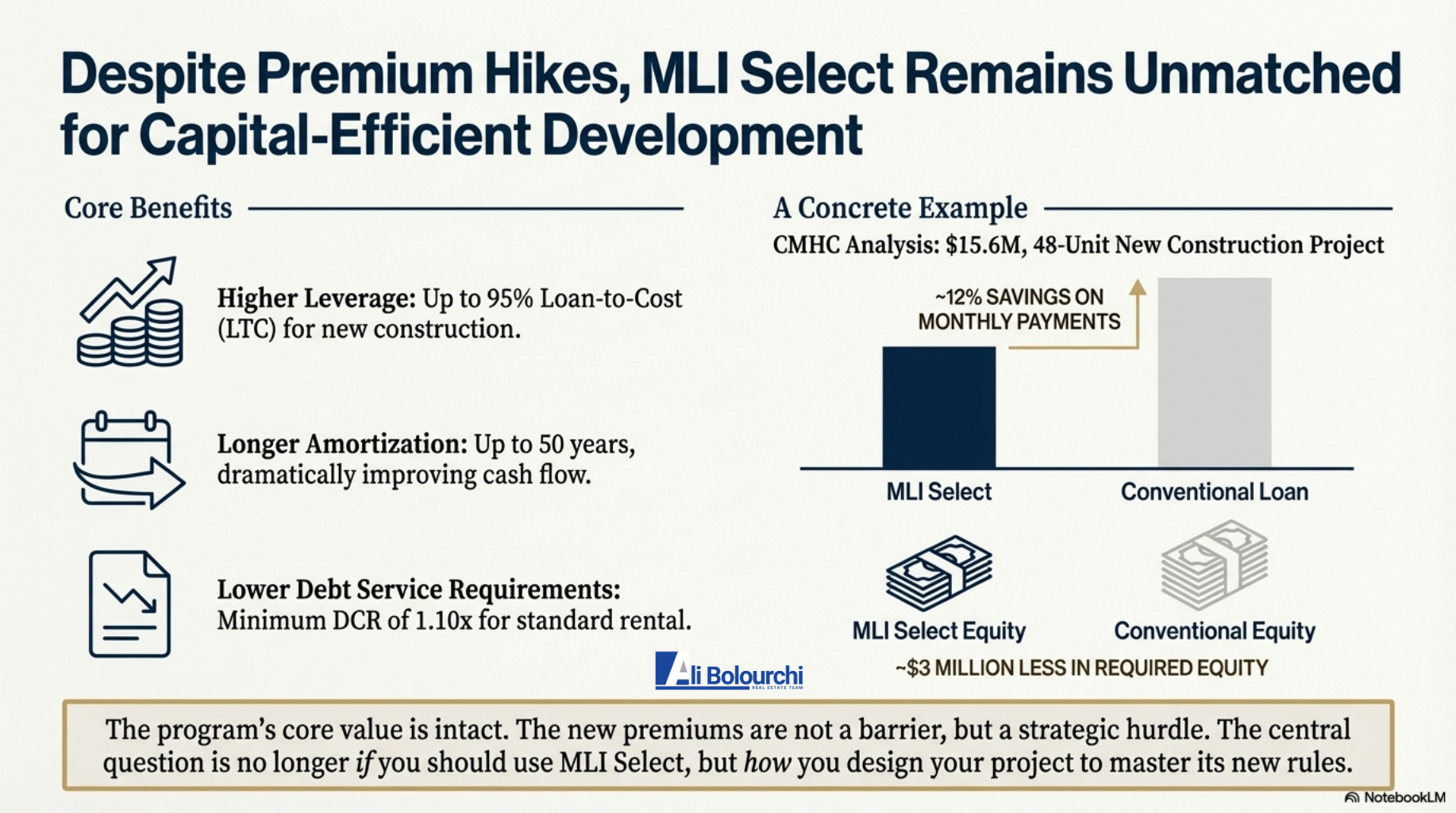
    • The program allows for a Loan-to-Value (LTV) or Loan-to-Cost (LTC) of up to 95%. This means you could potentially secure financing with a down payment as low as 5%, dramatically reducing the initial capital required to get a project off the ground.

  • Longer Amortization

    • MLI Select offers amortization periods of up to 50 years. A longer amortization significantly lowers monthly mortgage payments, which improves your property's monthly cash flow and makes projects more financially viable, especially in the early years.

  • Better Financing Terms

    • Because CMHC insurance protects the lender against default, lenders can offer lower interest rates and reduced insurance premiums compared to conventional commercial loans. This reduces the overall cost of borrowing over the life of the mortgage.

These powerful incentives are not automatic. To unlock them, your project must score points in a system designed to measure its social and environmental impact.
3. The Heart of the Program: Mastering the MLI Select Points System

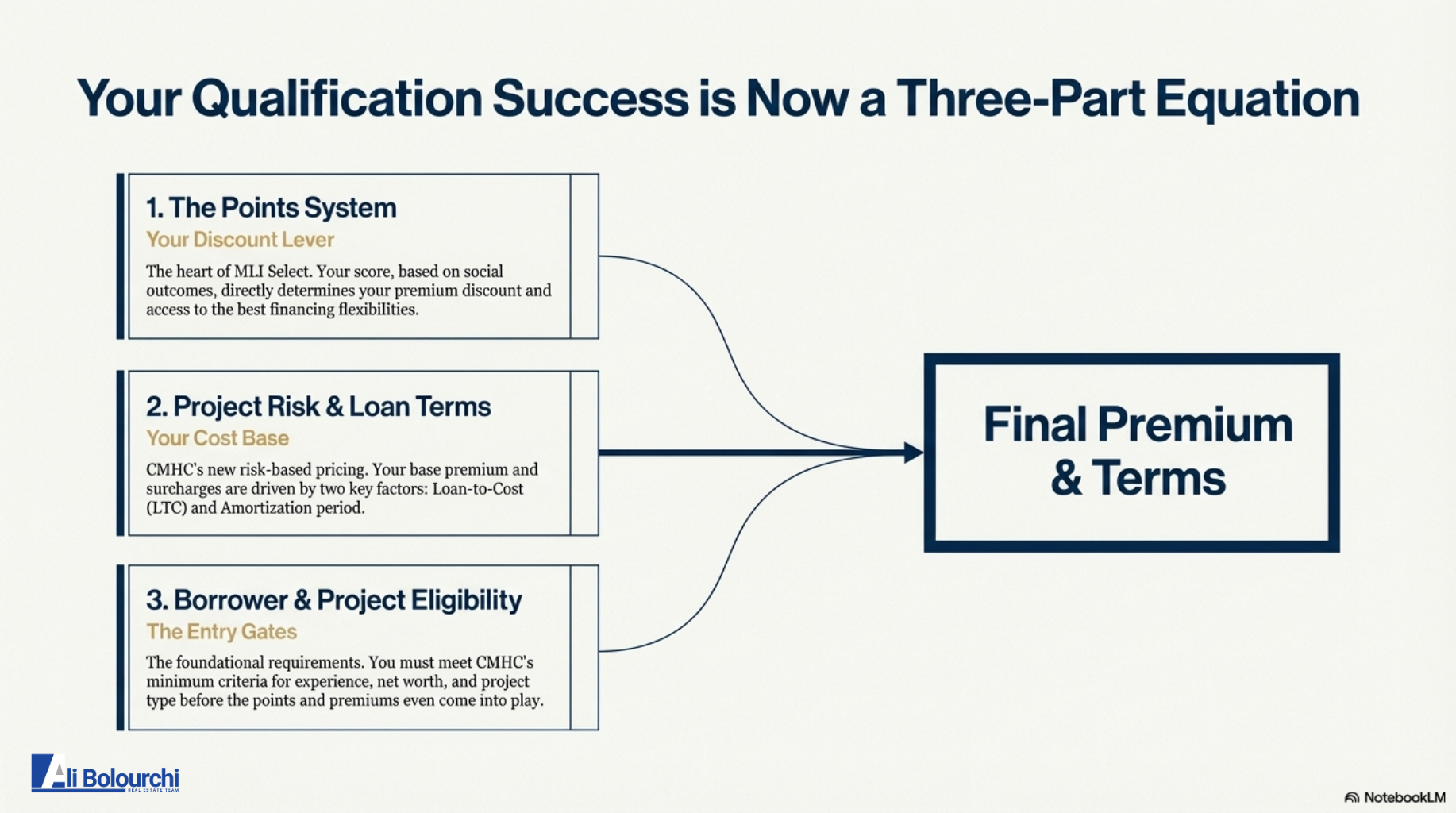
The entire MLI Select program is built on a points system. The more points your project scores, the better the financing terms you can access. To qualify, a project must achieve a minimum of 50 points, but savvy investors aim for 100+ points to maximize their benefits. Points are awarded across three "pillars":

  • Affordability

    • This is achieved by committing to rent a certain percentage of your units at or below 30% of the local median renter income. This commitment must be maintained for at least 10 years.

  • Energy Efficiency

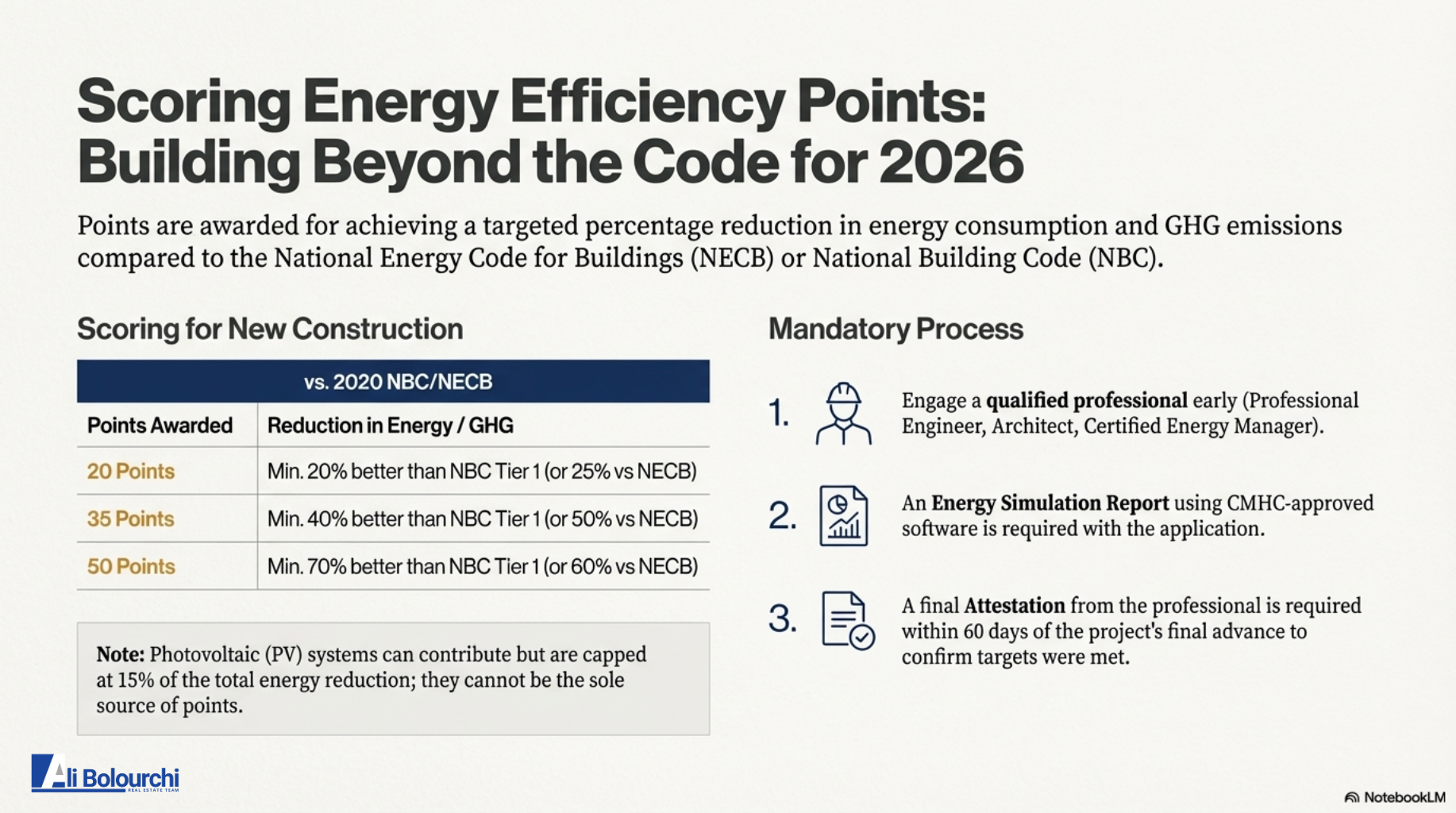
    • Points are awarded for designing a new building or retrofitting an existing one to achieve energy consumption and GHG emission reductions that exceed the standards of the National Energy Code.

  • Accessibility

    • This involves incorporating universal design principles and accessibility features for people with mobility challenges, based on standards like the CSA B651:23. This can range from making common areas barrier-free to ensuring a percentage of units are fully accessible.

Illustrate the Tiers of Success

For a new construction project, the benefits scale directly with your point score. The strategic goal is to reach 100 points to unlock the best possible terms.
Minimum Points Required

Key Benefits Unlocked

Strategic Goal

50 Points

Qualify for the program. Up to 95% LTC, up to 40-year amortization.

The entry-level tier.

70 Points

Improved terms. Up to 95% LTC, up to 45-year amortization.

A stronger project with better cash flow.

100+ Points

Maximum benefits. Up to 95% LTC, up to 50-year amortization, and access to limited recourse debt.

The strategic target for savvy investors.

A Strategic Blueprint for Success

Reaching 100 points is more achievable than it might seem, especially when you leverage long-term commitments. Here is a cost-effective "100-Point Blueprint" for a hypothetical 12-unit new construction project in Toronto:

  1. Pillar 1: Affordability (80 Points)

    • Commit just 10% of your units (2 out of 12) to affordable rents. This initial commitment earns 50 points.

    • Critically, commit to maintaining these affordable rents for 20+ years instead of the minimum 10. This long-term commitment grants a +30 point bonus.

    • Total Affordability Score: 80 Points

  2. Pillar 2: Accessibility (20 Points)

    • Design the building to meet the mandatory accessibility baseline: 100% of units must be "visitable" and all common areas must be barrier-free, as defined by the CSA B651:23 standard.

    • Ensure a minimum of 15% of the total units (2 out of 12) are fully accessible according to CSA standards. This combination earns 20 points.

    • Total Accessibility Score: 20 Points

  3. Pillar 3: Energy Efficiency (0 Points)

    • With 100 points already achieved through affordability and accessibility, no additional points are needed from this pillar. This allows you to build to the standard 2020 National Building Code without incurring the extra costs associated with higher-tier energy efficiency measures.

This strategic approach allows an investor to unlock the maximum financing benefits while minimizing additional construction costs. Understanding this points system is the first step; the next is navigating the new cost structure that CMHC introduced in 2025.

4. The New Math (Post-July 2025): How Your Premium is Calculated

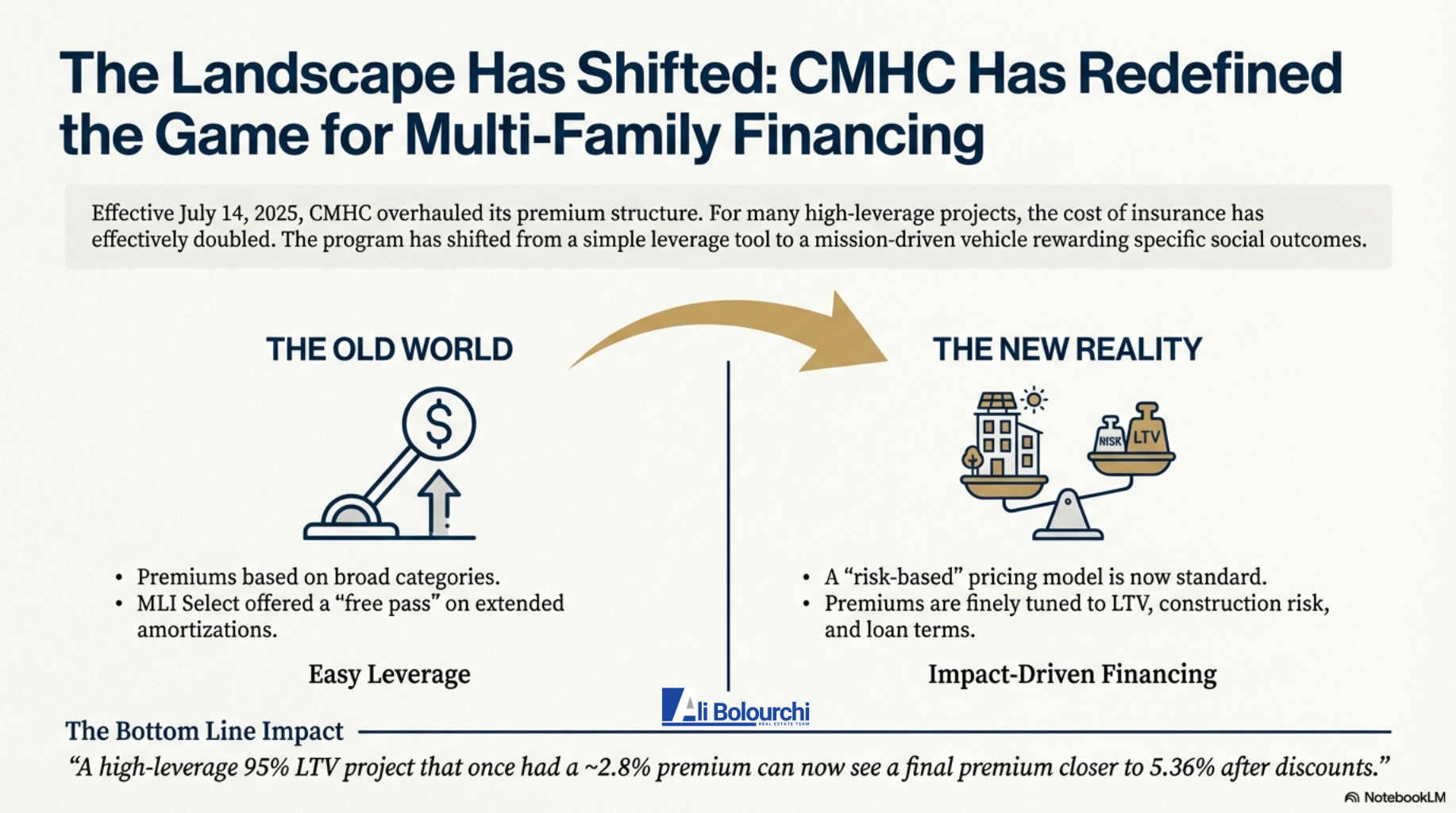
For applications submitted on or after July 14, 2025, CMHC overhauled its premium structure for multi-unit mortgage insurance. It is now essential for investors to understand this new "risk-based" pricing to accurately model a project's financial returns. The final premium you pay is now a three-part calculation.

  1. Base Premium Rate

    • This is your starting point. The rate is determined primarily by your project's risk, which CMHC measures through the Loan-to-Value (LTV) or Loan-to-Cost (LTC) ratio and whether it's a new construction or an existing property. Simply put: the higher your leverage, the higher your base premium.

  2. Applicable Surcharges

    • Additional fees are added on top of the base premium for certain features that increase the loan's risk. The most common surcharge is for extended amortization periods. Any amortization beyond 25 years will have a surcharge added.

  3. MLI Select Discount

    • This is your reward for achieving social outcomes. Based on your project's point score, a percentage discount is subtracted from the total of your Base Premium and Surcharges. The discounts are:

      • 50 Points: 10% discount

      • 70 Points: 20% discount

      • 100+ Points: 30% discount

Show, Don't Just Tell

The power of aiming for 100 points becomes clear when you compare two financial models. Let's look at a "Minimum Viable" 50-point project versus a "Strategic Max-Out" 100-point project.

Metric

Project A (50 Points)

Project B (100 Points)

LTC / Amortization

85% / 40 years

95% / 50 years

Base Premium

6.00%

7.00%

Amortization Surcharge

+0.75%

+1.25%

Unstabilized Income Surcharge

+0.25%

+0.25%

Total Raw Premium

7.00%

8.50%

MLI Select Discount

-10% (-0.70%)

-30% (-2.55%)

FINAL PREMIUM

6.30%

5.95%

The "So What?"

The table reveals a crucial insight: the 100-point strategy is financially superior. Even though Project B uses higher leverage (95% vs. 85%) and a longer amortization (50 vs. 40 years)—both of which increase the raw premium—the powerful 30% discount results in a lower final premium rate. An investor using the 100-point strategy puts less money down, improves their monthly cash flow, and—counter-intuitively—still pays less in total insurance costs. This is the new math of purpose-driven investment.
5. The Gates to Entry: Verifying Borrower and Project Eligibility

Before you can even begin scoring points, you and your project must meet CMHC's fundamental eligibility requirements. These are the non-negotiable gates to entry.

Borrower Requirements Checklist

  • Experience: You must have a minimum of 5 years of experience managing similar multi-unit residential properties.

    • Alternative: If you lack this experience, you can satisfy the requirement by having a formal contract with a professional third-party property management firm.

  • Net Worth: You must have a minimum net worth equal to at least 25% of the total loan amount, with an absolute minimum of $100,000.

    • Strategic Note: CMHC may offer flexibility on this requirement for projects that achieve 100+ points.

Project Requirements Checklist

  • Minimum Size: The property must have at least 5 rental units.

  • Mixed-Use Limits: If the property includes commercial space (e.g., retail on the ground floor), the non-residential portion cannot exceed 30% of the gross floor area or 30% of the total lending value.

  • Foreign Ownership: The project cannot be subject to the Prohibition on the Purchase of Residential Property by Non-Canadians Act.

Once you've confirmed you meet these baseline criteria, you can move forward with the application process.

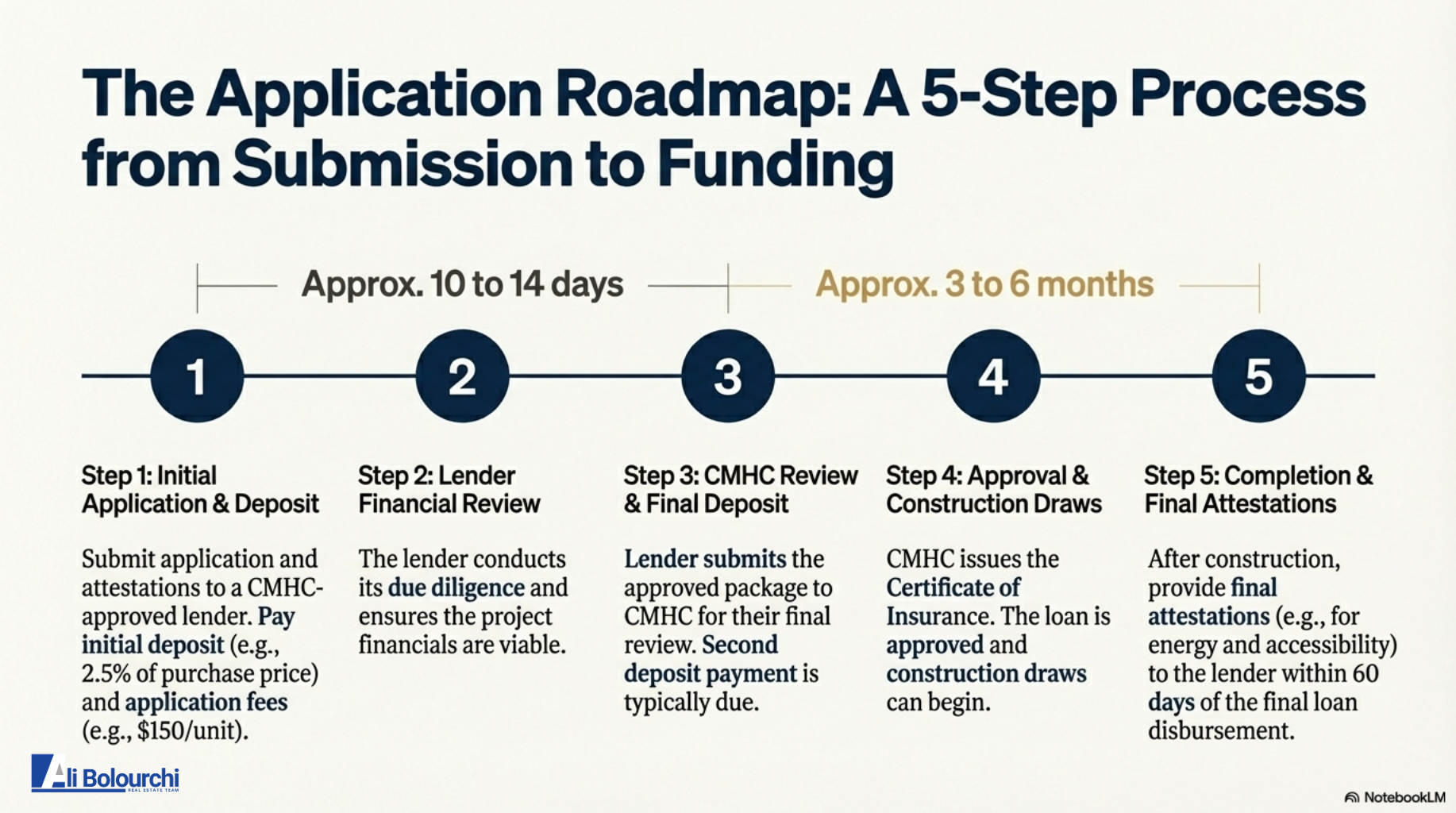
6. The Application Roadmap: A 5-Step Process from Submission to Funding

The application process for an MLI Select-insured loan is thorough and requires careful planning. Understanding the timeline and key milestones is crucial for managing expectations.

  1. Initial Application & Deposit

    • Submit your application forms and signed attestations (for affordability, accessibility, etc.) to a CMHC-approved lender. At this stage, you will pay the initial application deposit and application fees (calculated based on the number of units).

  2. Lender Financial Review (Approx. 10-14 days)

    • The lender performs its own due diligence. They will review your financials, analyze the project's pro forma, and ensure the deal is viable before submitting it to CMHC.

  3. CMHC Review & Final Deposit (Approx. 3-6 months)

    • Once the lender approves the package, it is sent to CMHC for their detailed review. This is the longest part of the process. A second deposit payment is typically due at this stage.

  4. Approval & Construction Draws

    • Upon successful review, CMHC issues a Certificate of Insurance. This is the official approval. The loan is finalized, and if it's a new build, construction draws can begin.

  5. Completion & Final Attestations

    • After construction is complete, you must provide the final signed attestations from qualified professionals (e.g., an energy advisor or architect) to your lender. This must be done within 60 days of the final loan disbursement to confirm you've met your commitments.
7. Conclusion: Your Blueprint for a Successful Investment

The CMHC MLI Select program represents a fundamental shift in how multi-unit rental projects are financed in the GTA. It is a strategic tool where financial success is directly linked to achieving positive social and environmental outcomes. The days of treating affordability or accessibility as optional add-ons are over; under the new 2025 rules, they are the core drivers of profitability.

For new investors, the path to success is clear: engage in careful, early-stage planning. Model your project to achieve 100 points from day one. By strategically leveraging the long-term affordability commitment and baseline accessibility standards, you can unlock the program's maximum benefits—higher leverage, longer amortization, and lower premiums—creating a more resilient and profitable investment for your future.

Read

Your 2026 Guide to Buying a Home in the GTA: How New Rebates Can Save You $130,000

1. Introduction: Turning Toronto Homeownership Dreams into Reality

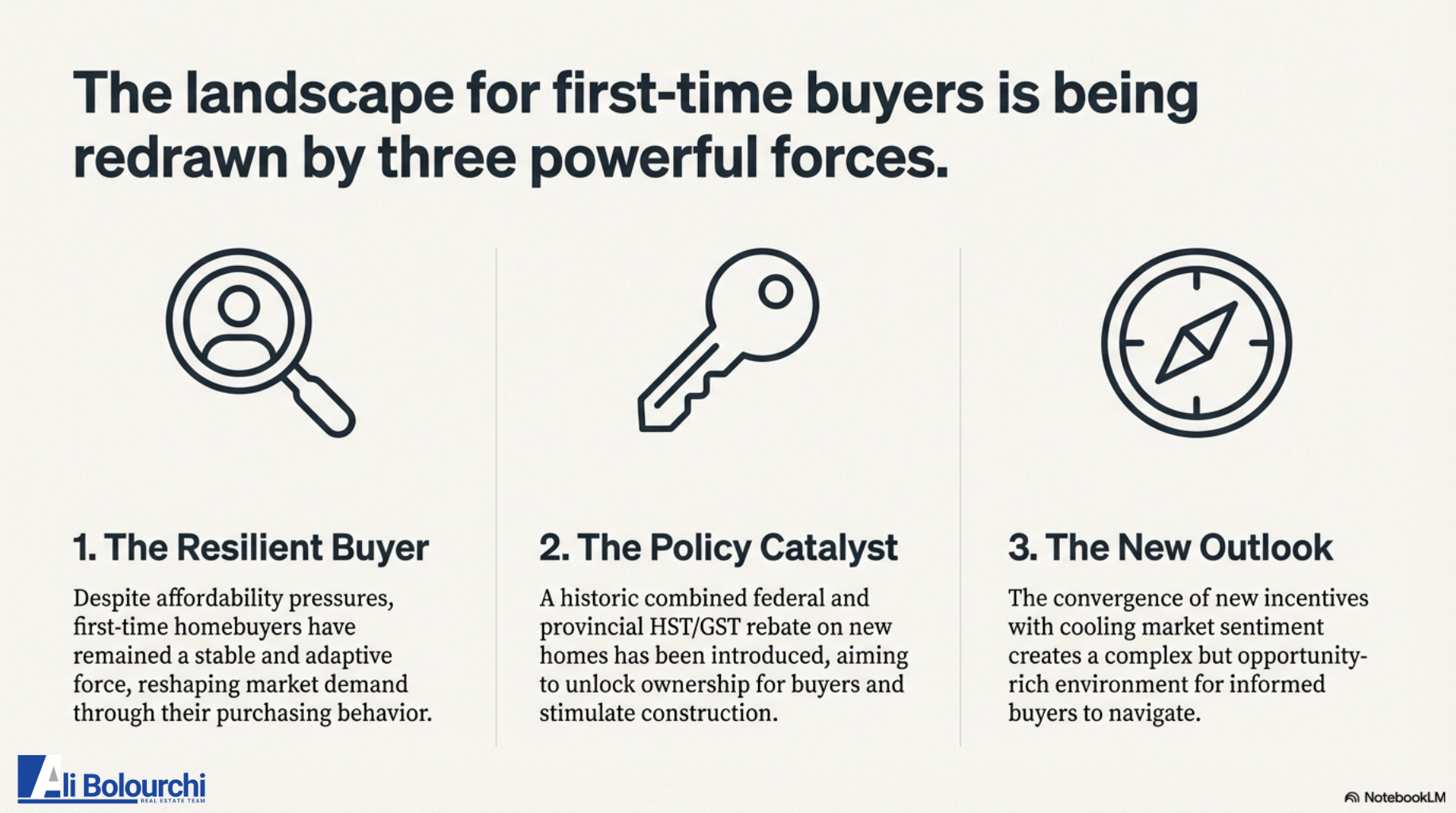
For many aspiring first-time home buyers, the Greater Toronto Area (GTA) housing market can feel impossibly out of reach. The dream of ownership often seems to clash with the reality of high prices and intense competition. However, a unique window of opportunity is opening in 2026, driven by a combination of key market shifts and the most significant government incentives seen in recent memory.

This guide provides a clear, step-by-step roadmap for navigating the 2026 GTA market. Its purpose is to demystify the powerful new federal and provincial rebate programs that can dramatically increase your purchasing power and turn the dream of homeownership into a practical, achievable plan.

2. The 2026 GTA Real Estate Landscape: A First-Time Buyer's Perspective

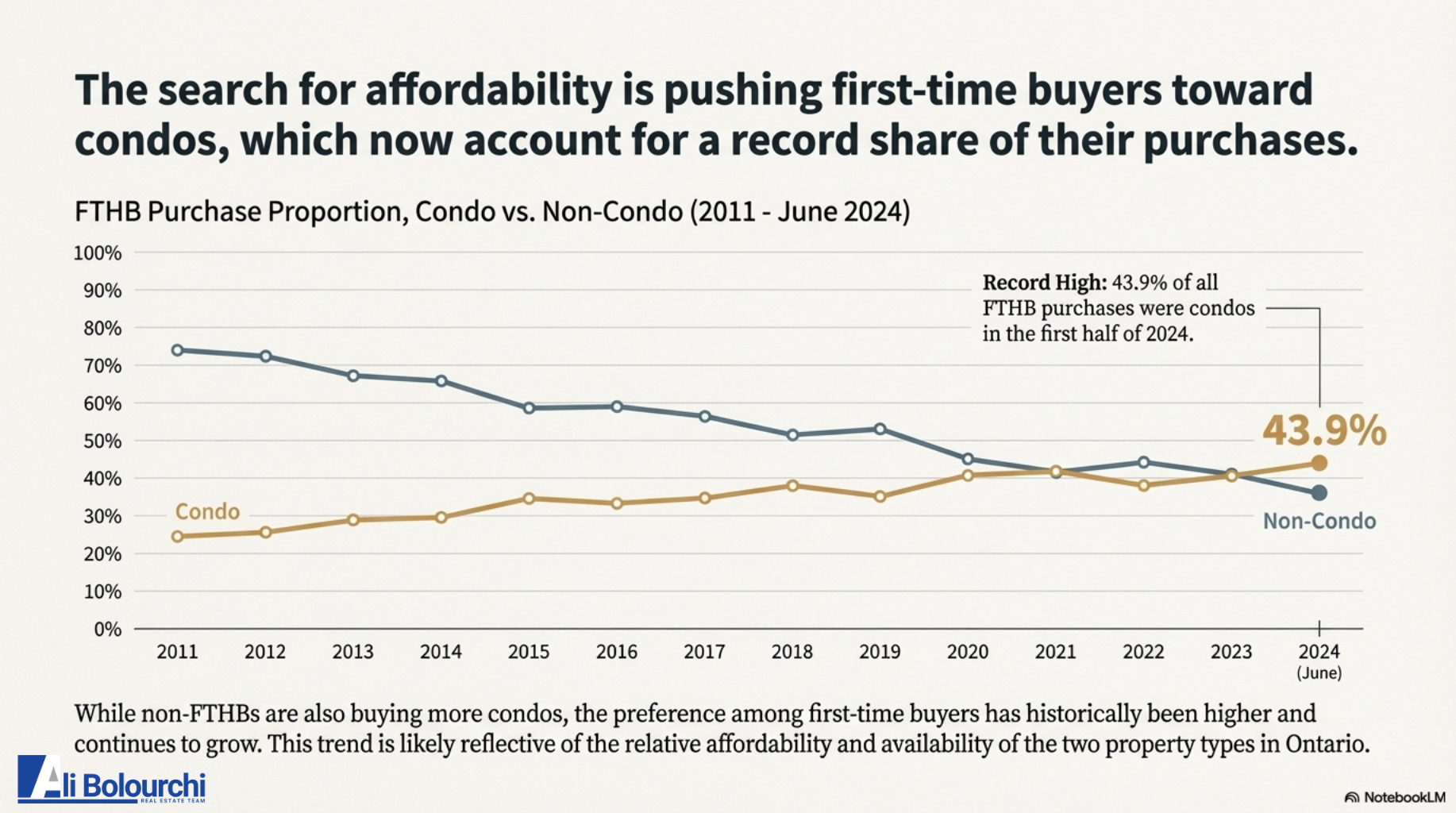
After a significant decline in sales volume in 2023, the Ontario housing market stabilized through 2024, creating a more balanced environment for buyers. For first-time home buyers (FTHBs), condominiums in particular represent a key opportunity to enter the market.

Market data reveals several important trends:

Condos Are Leading the Recovery: In the 12 months leading up to June 2024, condo sales volumes recovered faster than other property types, showing an 8.3% year-over-year increase.

Condos Are the FTHB Entry Point: In the first half of 2024, condo properties accounted for a significant 43.9% of all purchases made by first-time home buyers.

A Price Opportunity Exists: Condo prices across the GTA have cooled, creating a potential buying advantage. While the City of Toronto saw a modest 5.1% year-over-year decline in the third quarter of 2025, surrounding regions experienced even more dramatic drops. Halton region saw condo prices fall by 12.1% and Peel region by 11.5% in the same period, powerfully reinforcing the case for looking beyond the downtown core.

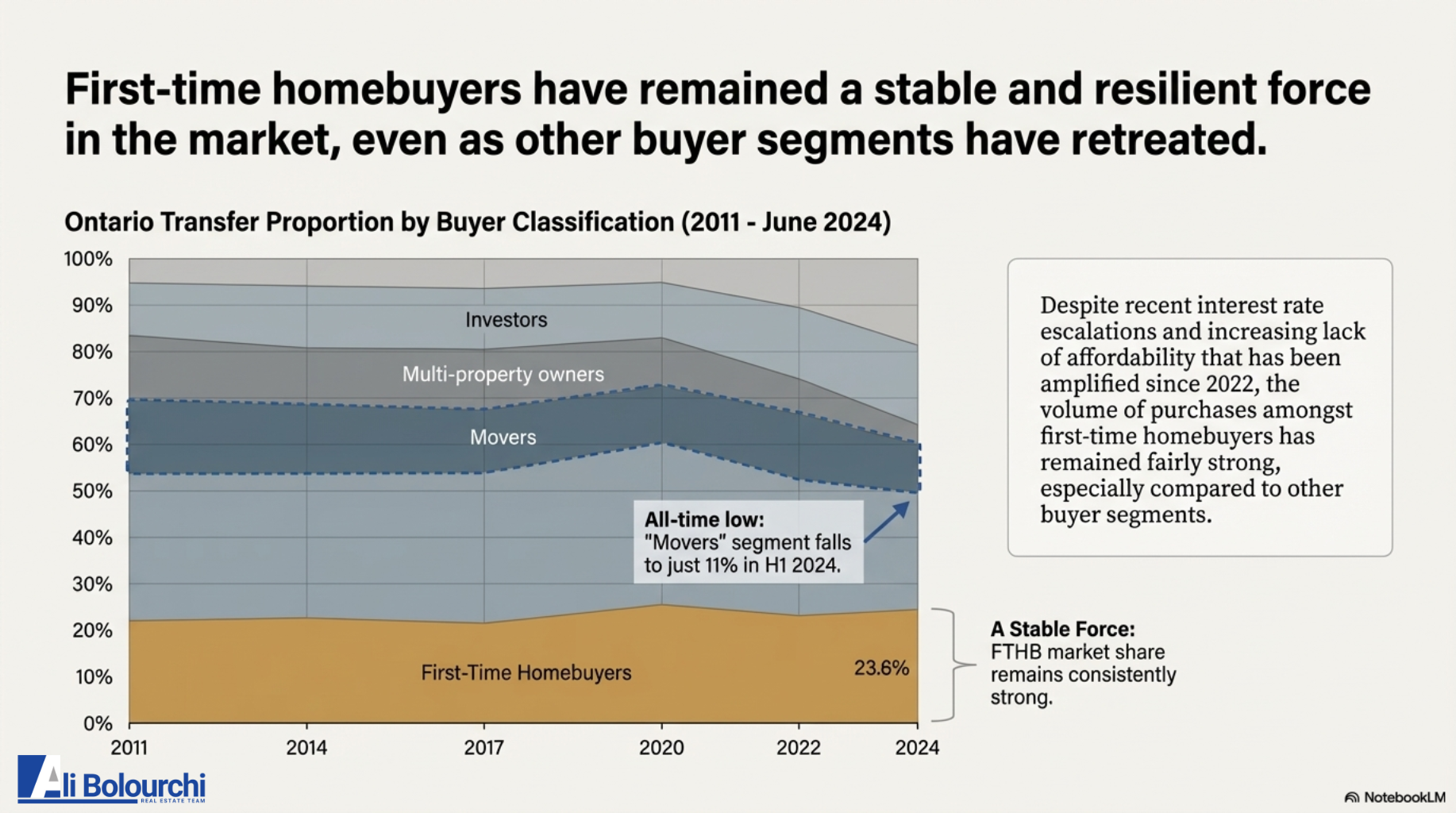
First-time buyers have proven to be a resilient and stable segment of the market, consistently comprising between 20% and 23.6% of all property purchases since 2011. While Toronto remains the top destination for FTHBs, accounting for approximately 20% of activity, its popularity is waning due to affordability challenges. This has led a growing number of buyers to explore surrounding GTA regions like Peel, York, and Durham, as well as emerging communities like Waterloo, in search of better value.

3. The Game-Changer: Unlocking Up to $130,000 in New Home Rebates

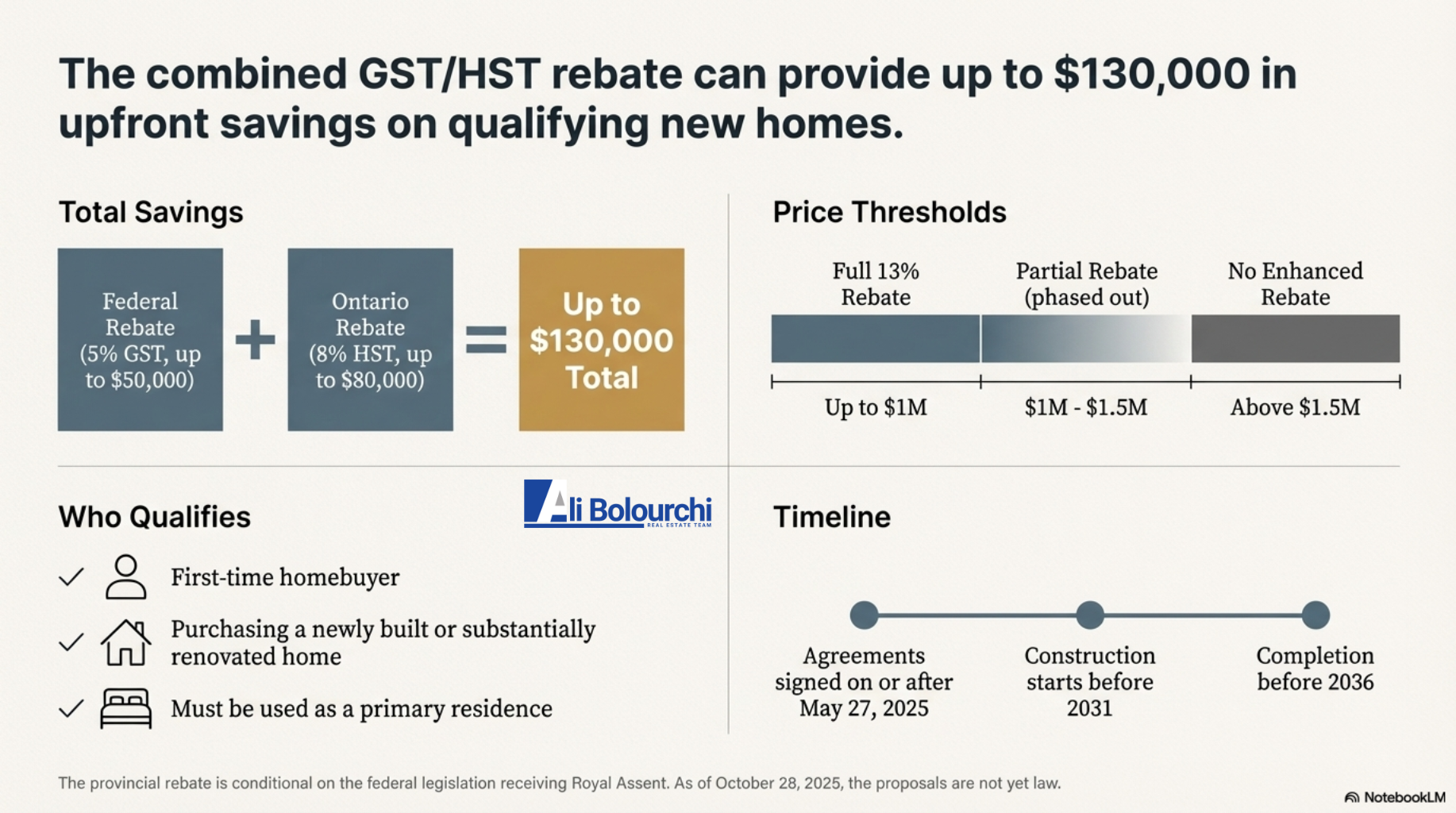
The single biggest financial benefit for first-time buyers in 2026 is a set of new, coordinated Harmonized Sales Tax (HST) rebates from the federal and provincial governments. Aimed at buyers of newly built homes, these programs can dramatically reduce the upfront cost of a purchase.

3.1. The Federal First-Time Home Buyers’ GST Rebate

The Government of Canada has proposed a new rebate that removes the 5% federal portion of the HST—the Goods and Services Tax (GST)—for qualifying first-time home buyers purchasing new homes. This measure provides substantial savings directly at the point of purchase.

Metric
Value
Explanation
Example New Home Price
$900,000
A common price point for new condos in the GTA.
Federal GST (5%)
$45,000
The tax applied before the rebate.
FTHB GST Rebate
-$45,000
The full 5% is rebated.
Potential Federal Savings
$45,000
This amount is effectively removed from the purchase cost.

3.2. Ontario's Matching HST Rebate

The Ontario government has announced its intention to match the federal initiative by rebating the full 8% provincial portion of the HST on qualifying new homes priced up to $1 million.

Crucially, this provincial rebate is conditional. It will only proceed if the federal government's proposed changes to the GST are formally passed into law.

This new program works by enhancing Ontario's existing HST New Housing Rebate. The previous rebate was worth up to $24,000; the new program, when combined with the old one, ensures the full 8% provincial tax is rebated on qualifying new homes up to the $1 million threshold.

3.3. Putting It All Together: A Hypothetical Example

The combined impact of the federal and provincial rebates is transformative. For a first-time buyer purchasing a new home at the $1 million price point, the entire 13% HST could be eliminated, resulting in a six-figure savings.

Example: Combined Savings on a $1,000,000 New Home

Line Item
Amount
Description
Purchase Price
$1,000,000
The builder's price for a new home.
Federal GST (5%)
+$50,000
The federal tax portion.
Provincial HST (8%)
+$80,000
The provincial tax portion.
Price Including Taxes
$1,130,000
Total cost before rebates.
Federal GST Rebate
-$50,000
Maximum federal savings.
Provincial HST Rebate
-$80,000
Maximum provincial savings.
Total Potential Savings
$130,000
The combined value of the new rebates.
Final Price Before Other Costs
$1,000,000
The taxes are effectively removed for the FTHB.

3.4. Are You Eligible? Key Criteria for the Rebates

To qualify for these new HST/GST rebates, you and the home you are purchasing must meet specific criteria.

Who Qualifies:

    ◦ You must be a first-time home buyer, defined as not having owned a home you (or your spouse/common-law partner) lived in within the last four calendar years.

    ◦ You must be at least 18 years old and a Canadian citizen or permanent resident.

What Homes Qualify:

    ◦ The property must be a newly built home or a substantially renovated home. Resale properties do not qualify.

    ◦ The home must be intended for use as your primary place of residence.

Important Timing:

    ◦ The rebates apply to purchase agreements entered into on or after May 27, 2025, and before 2031.

4. Your Practical Roadmap to Homeownership in 2026

With this new landscape in mind, here are four actionable steps to begin your journey.

4.1. Step 1: Secure Your Financing

The first and most critical step is to get pre-approved for a mortgage. This will give you a clear understanding of your budget and show sellers and builders that you are a serious buyer. For first-time buyers in urban areas like the GTA, the Big 5 Banks are the dominant lenders, accounting for 70% of all FTHB financing activity in the first half of 2024.

4.2. Step 2: Understand Your Costs and Savings

Beyond your down payment, you will need to budget for closing costs, which include legal fees and land transfer tax. The new HST/GST rebates, offering up to $130,000 in savings, are a massive benefit that can significantly offset these upfront costs. It’s also important to remember that as a first-time buyer in Ontario, you already benefit from the provincial Land Transfer Tax Rebate, which further reduces your closing expenses.

4.3. Step 3: Find an Expert Guide

The 2026 market is defined by new opportunities and complex programs. It is essential to work with a real estate agent and a mortgage broker who specialize in the first-time home buyer market. An expert guide will be deeply familiar with the eligibility rules and application processes for these new rebates, ensuring you can maximize your savings.

4.4. Step 4: Focus Your Search

Use the current market data to your advantage. Condos are the most accessible entry point into the market, and the recent cooling of condo prices presents a strategic opportunity to buy. To get the most for your budget, broaden your search beyond Toronto's core. Regions like Halton and Peel have recently seen double-digit declines in condo prices (down 12.1% and 11.5% year-over-year, respectively), creating significant buying opportunities that are increasingly popular with first-time buyers.

5. Conclusion: Your Window of Opportunity is Open

The current market—defined by stabilizing prices and unprecedented government rebates for new builds—presents a rare and powerful opportunity for determined first-time buyers in 2026. The potential savings of up to $130,000 represents a direct government investment in your homeownership journey, making it more attainable than it has been in years.

Start your research, get pre-approved, and connect with a professional who can help you navigate these game-changing programs. Your dream of owning a home in the GTA is closer than you think.

Read

The "Wait and See" Trap: Why November’s Dip is the Golden Window First-Time Buyers Have Been Praying For

Is the market crashing, or is it correcting? If you are a First-Time Home Buyer sitting on the sidelines, the difference between those two words could be worth tens of thousands of dollars to your future net worth.

The November 2025 numbers are in, and the story they tell is one of opportunity. While the headlines scream about sales dropping, the savvy observer sees something else: leverage.

Here is the breakdown of what happened in the Greater Toronto Area (GTA) real estate market this month, how the "416" compares to the "905," and why the window to get in at a discount might be closing faster than you think.

The Big Picture: Buyers Are Pausing, But Should You?

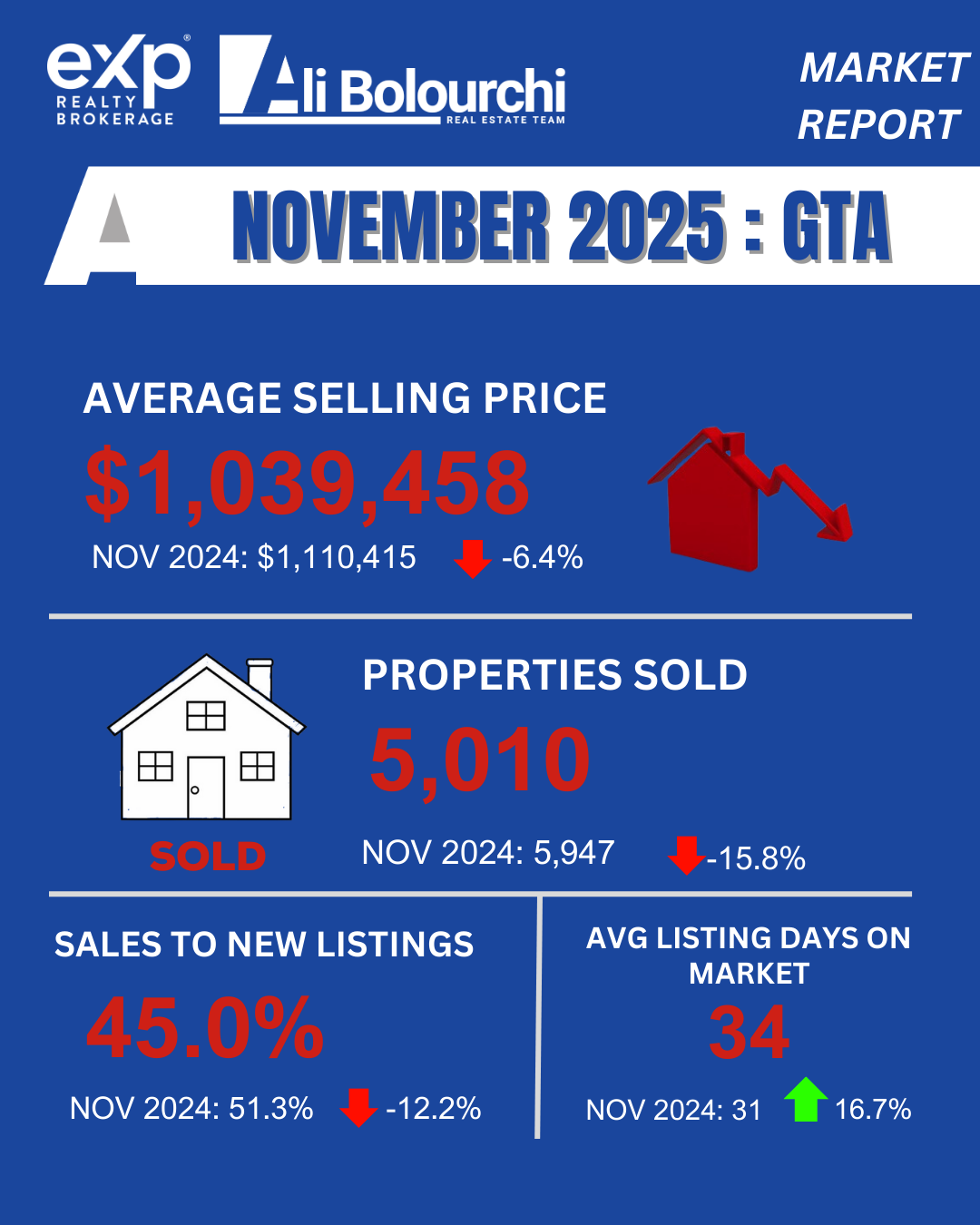
In November 2025, we saw 5,010 home sales, which is down 15.8% compared to last year. At the same time, the average selling price dipped by 6.4% to $1,039,458.

What does this mean? It means intending homebuyers are sitting on the sidelines, waiting for "more positive economic news". But here is the secret: once that "positive news" arrives and confidence strengthens, everyone will rush back into the market at the same time, driving prices up.

Currently, we have a unique combination of factors working in your favor:

  • Lower Borrowing Costs: The Bank of Canada Overnight Rate has dropped to 2.3%.

  • More Inventory: Active listings are up 16.8% year-over-year.

  • Less Competition: With sales down, you aren't fighting 20 other offers on offer night.

The Breakdown: 416 (Toronto) vs. 905 (Suburbs)

Real estate is hyper-local. A condo in downtown Toronto acts differently than a detached home in the suburbs. Let’s look at the prices by property type to see where the value lies.

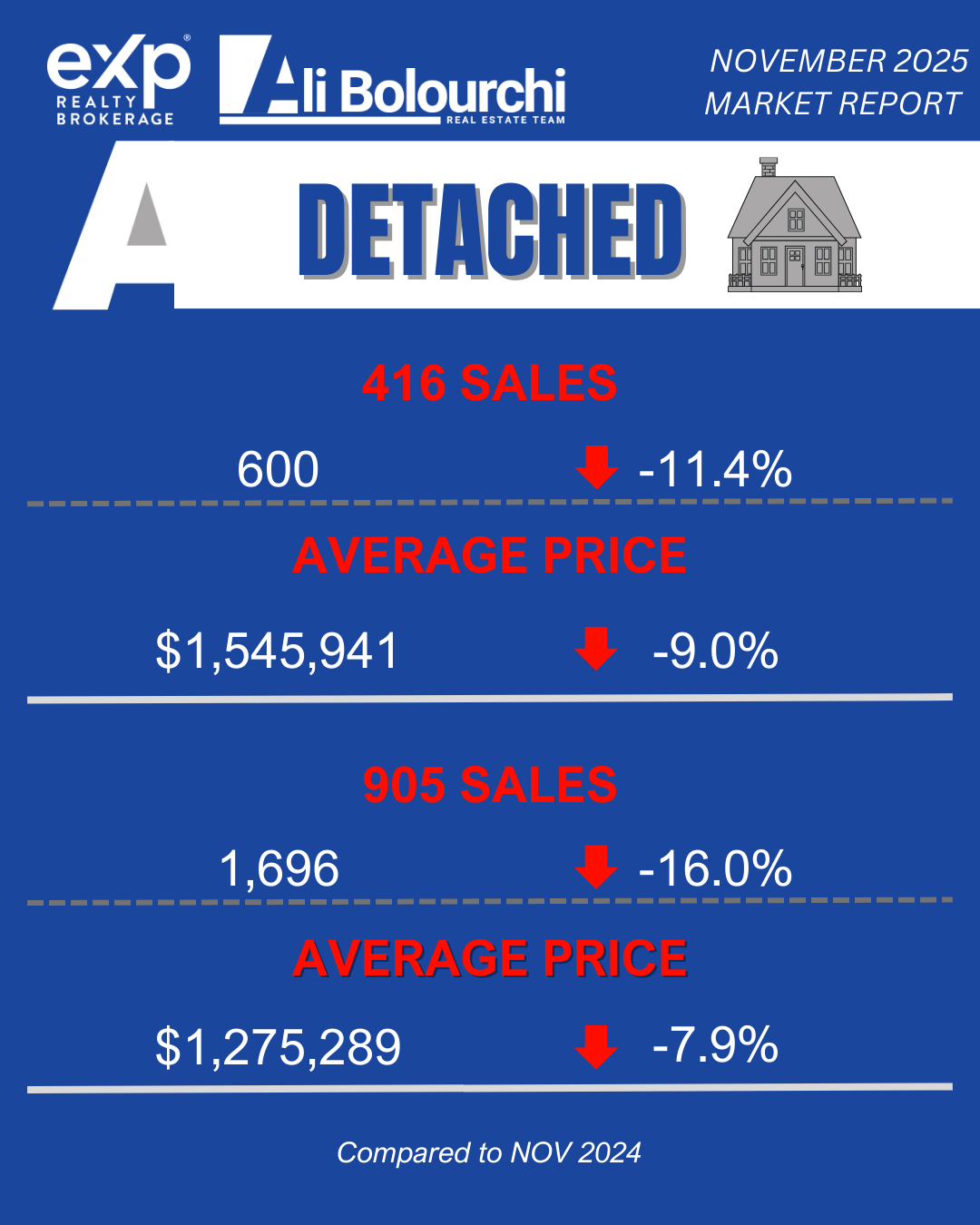
Detached Homes: The Crown Jewel

If you are looking for the white picket fence, prices have softened, making the upgrade more attainable.

  • 416 (Toronto): Average price is $1,545,941 (Down 9.0%).

  • 905 (Suburbs): Average price is $1,275,289 (Down 7.9%).

  • Market Insight: Detached homes in the 416 saw sales drop by 16.0%, creating significant negotiating room for buyers.

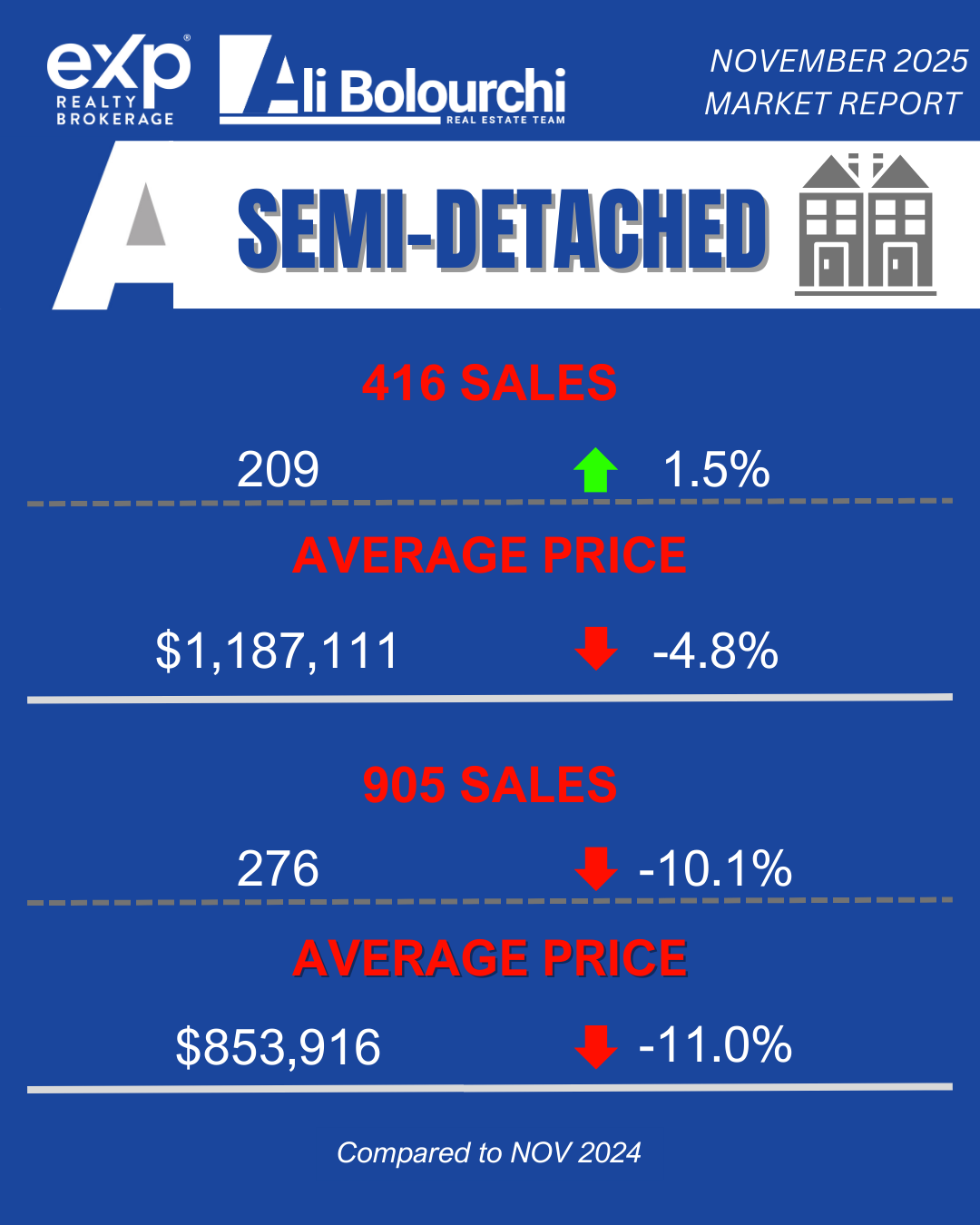
Semi-Detached: The Competitive Middle Ground

  • 416 (Toronto): Average price is $1,187,111 (Down 4.8%).

  • 905 (Suburbs): Average price is $853,916 (Down 11.0%).

  • Market Insight: Note the massive gap here. You can save over $330,000 by crossing the border into the 905 for a semi-detached home. The 905 Semis took a double-digit price hit (-11.0%), making this a prime target for value hunters.

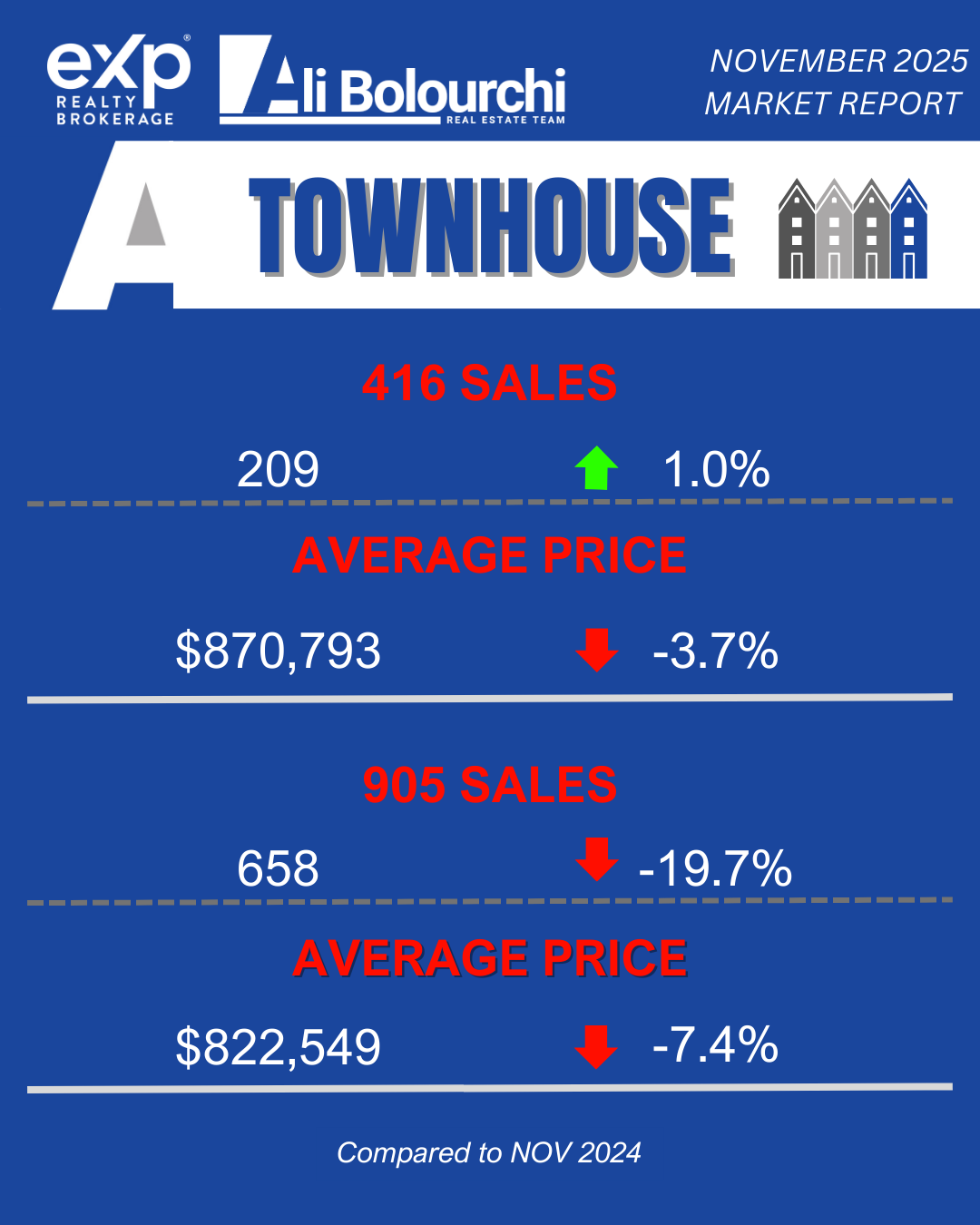
Townhouses: The First-Time Buyer Favorite

  • 416 (Toronto): Average price is $870,793 (Down 3.7%).

  • 905 (Suburbs): Average price is $822,549 (Down 7.4%).

  • Market Insight: The price gap here is narrow (approx. $48k). If you work downtown, the premium to stay in the 416 might actually be worth the commute savings.

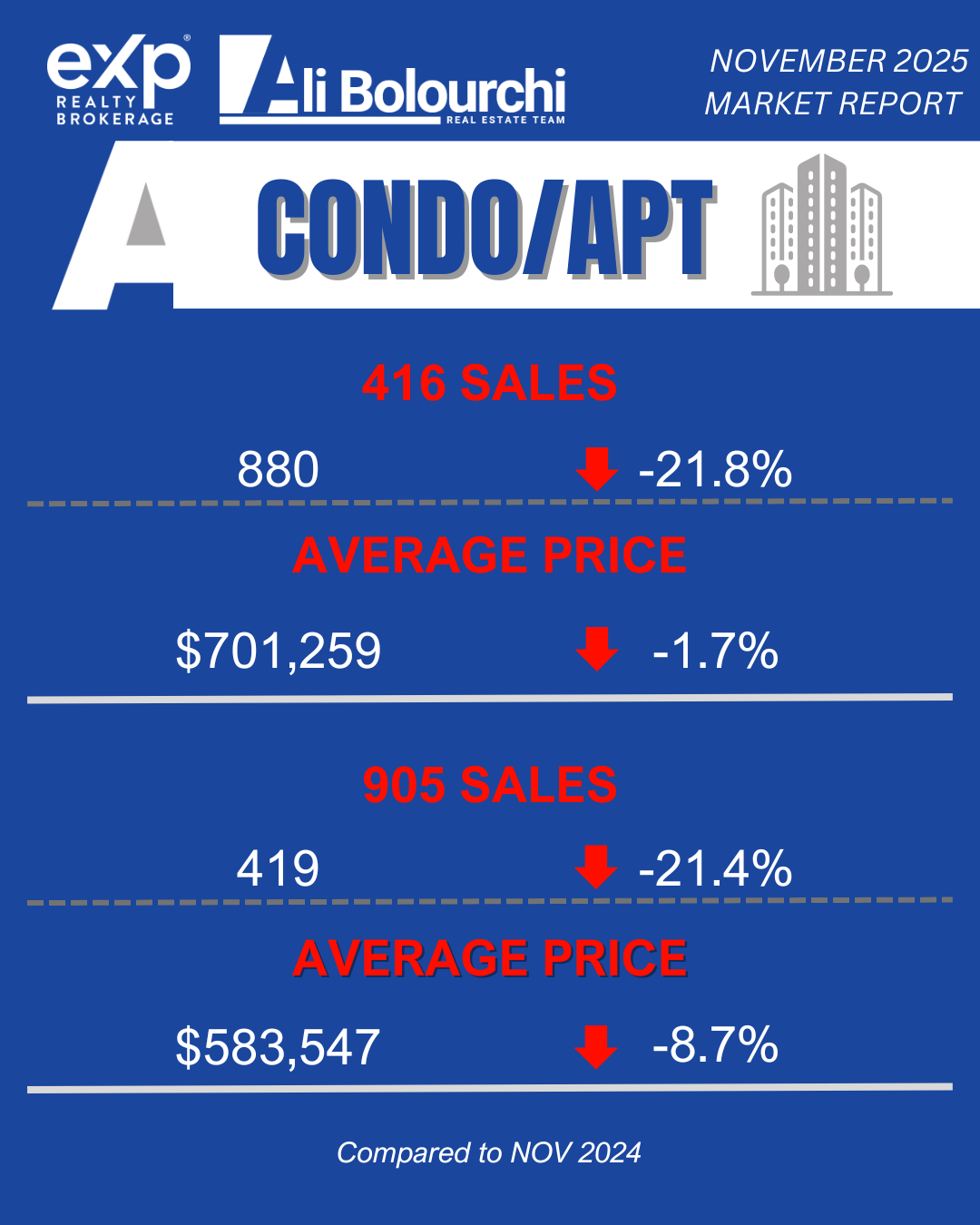
Condo Apartments: The Entry Point

  • 416 (Toronto): Average price is $701,259 (Down 1.7%).

  • 905 (Suburbs): Average price is $583,547 (Down 8.7%).

  • Market Insight: Condo sales took the biggest hit, down over 21% across the board. With 905 condos averaging well under $600k, this is the most accessible entry point we have seen in years.

Critical Advice for November 2025

For First-Time Home Buyers (FTHB)

This is your "Goldilocks" moment. We are seeing encouraging news on jobs and the broader economy. If this momentum continues into 2026, consumer confidence will return, and prices will rise.

You have a chance right now to buy while inventory is high (24,549 active listings) and rates are trending down. Do not wait for the competition to wake up.

Are You Financially Ready to Strike?

Before you start booking showings, you need to know your numbers. Can you handle the deposit? Do you know your credit score?

  • Check Your Readiness: Visit our Financial Readiness Guide to calculate your budget and understand the hidden costs of closing.

The Bottom Line

The Toronto Regional Real Estate Board President, Elechia Barry-Sproule, put it best: buyers are on the sidelines waiting for confidence.

Be the buyer who acts on data, not just confidence.

If you are ready to stop renting and start owning, let’s look at the numbers for your specific neighborhood. The window is open, but it won't stay open forever.

Read
This website may only be used by consumers that have a bona fide interest in the purchase, sale, or lease of real estate of the type being offered via the website. The data relating to real estate on this website comes in part from the MLS® Reciprocity program of the PropTx MLS®. The data is deemed reliable but is not guaranteed to be accurate.